Appearance
14. Inside the 2016 Draft Lottery with Brendan Shanahan
Standing inside Sportsnet’s studios, Brendan Shanahan’s mind races in the split seconds before deputy NHL commissioner Bill Daly flips each of the cards that will determine the future of his franchise.
It’s April 30, 2016, almost exactly two years after his hiring as Maple Leafs president and just three weeks after the conclusion of his second season, and Shanahan is already attending the NHL Draft Lottery for a second time.
This one feels different than the first one, though.
A year ago, he was ushered into a back room to observe the drawing of the lottery balls himself. This year, he and the other team representatives gathered at the Canadian Broadcasting Centre on Front Street in Toronto’s downtown core were asked to stand on set, with no knowledge of who had won or lost, to learn their fate as the national TV audience did. A year ago, his Leafs had finished his first full season at the helm with 68 points and the fourth-worst record in the league, positioning them with just a 9.5 percent chance to win a lone lottery for the first overall pick in the 2015 NHL draft. So when they didn’t win, even after infamously entering the drawing of the fourth and final ball with the best odds (after balls 5, 14, and 6 were drawn, the Leafs held four of the remaining 11 winning combinations to the Sabres’ three, the Oilers’ two, and the Hurricanes’ and Blue Jackets’ one apiece), it didn’t sting when they stayed put and eventually drafted Mitch Marner, their target after the big two of Connor McDavid and Jack Eichel were gone.
Now, though, the stakes are higher. They’re higher because the lottery has changed, replacing a single draw for the first overall pick with one for each of the first three. They’re higher because Shanahan’s Leafs have just finished with the league’s worst record, giving themselves a combined 52.5 percent chance at winning one of the three lotteries (which breaks down to 20 percent at first, 17.5 percent at second, and 15 percent at third), and guaranteeing a pick no lower than fourth. They’re higher because even though he’d promised a rebuild, Shanahan knows that he can only show up to the lottery in good faith so many times, and every appearance without a win heightens the pressure on the next. And they’re higher because he’s representing the Leafs and the five decades of accumulating baggage that comes with them.
As Daly begins to turn over the cards, revealing the draft’s order in a countdown from the 14th pick, Shanahan checks mental boxes in his head, crossing each team off the league’s standings, which he has imprinted on his memory.
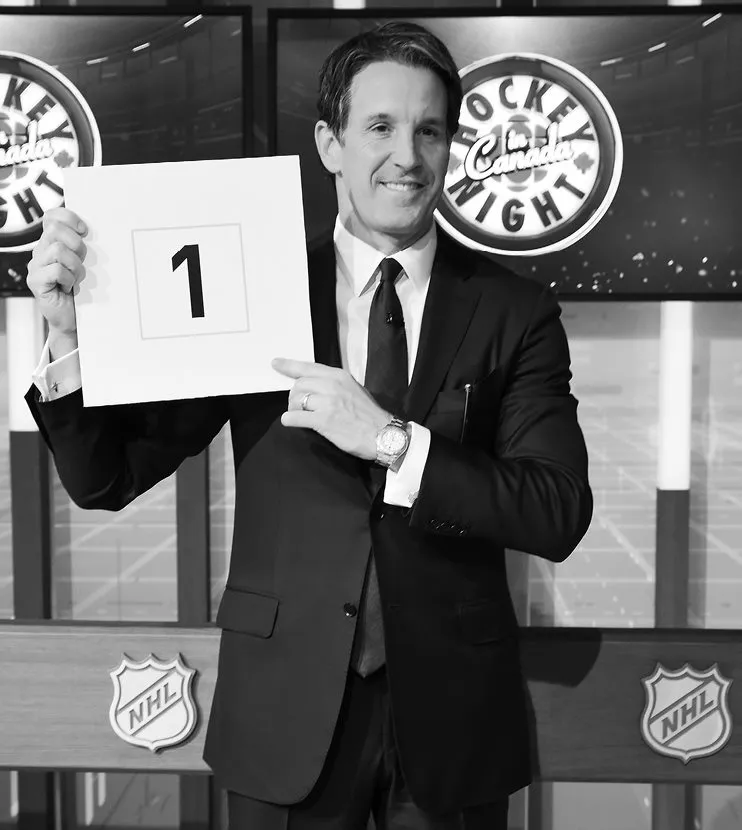
Brendan Shanahan pictured with Leafs draft history, as decided by ping pong balls. (Graig Abel/NHLI via Getty Images)
As each card flips, the crowd of team representatives who surround him begins to shrink and the same word flashes through his brain.
14. Boston Bruins
Good.
13. Carolina Hurricanes
Good.
12. Ottawa Senators
Good.
11. New Jersey Devils
Good.
10. Colorado Avalanche
Good.
9. Montreal Canadiens
Good.
8. Buffalo Sabres
Good.
7. Arizona Coyotes
Good.
Then there’s a ripple for the first time and his heart skips a beat as the Flames logo is revealed for the sixth overall pick, meaning the Winnipeg Jets, who hold the sixth-best odds, are among one of the three winners—and the Flames are the first team to fall a spot.
Then there’s another ripple in quick succession at fifth overall. It’s the Canucks, who held the third-best odds, so the Blue Jackets, whose turn it was supposed to be, have won a second of the three lotteries.
Knowing that just the Leafs and the Oilers remain for the final spot inside the top three, Shanahan’s heart rate picks up and his mind races in the brief seconds that follow before the No. 4 pick is revealed.
Be Edmonton. Be Edmonton, he thinks to himself. Just be in the top three.
When it’s the Oilers logo that lifts off the small podium in front of Daly, he allows himself to smile, feeling as though a spot inside the top three is a victory. But as the broadcast cuts to commercial break, and he stands alone on the set with Blue Jackets president John Davidson and Jets general manager Kevin Cheveldayoff, his brief thoughts of fair play and oh, thank god, we’re gonna get a good player disappear in an instant, replaced by something else.
In the two minutes that pass before cameras begin to roll again, his optimism makes way for the same four words, repeated over and over in his head.
I want to win. I want to win. I want to win, he thinks to himself. I want the first pick. We deserve something good to happen to this organization. I don’t want second, I want to win.
Then, as they return from commercial, the moment of truth arrives, and Daly is back at the podium to announce the order of the top three.
“The No. 3 overall selection in the 2016 NHL draft belongs to…the Columbus Blue Jackets,” Daly says, flipping another white card.
As he does, the camera quickly cuts away to Shanahan, Davidson, and Cheveldayoff. Davidson turns to the other two, extending his hand to shake theirs before exiting the shot.
Shanahan turns back to Cheveldayoff, cracking from his cold exterior to flash a bit of a smirk before adjusting his suit and placing his hands in front of himself, knowing that he’s being watched by the camera—and the hockey world.
Out of sight and off camera, the voice of studio host Darren Millard speaks out as suspenseful music is piped into the studio and the broadcast.
“That leaves Winnipeg and Toronto,” Millard says, as the shot of Shanahan and Cheveldayoff splits into a double frame shared with Daly.
Stuck in a trance in his place, Shanahan’s mind continues to race with different ways of thinking the same thing. I don’t want No. 2. I want No. 1. We need something to fall our way. It’s been a long time since something really fell correctly.
In the time between when Daly turns over the Blue Jackets logo for third overall and he reveals the team that will pick first, skipping over the second pick as an order of process and television theatrics, just 40 seconds pass.
To Shanahan, though, it feels like an eternity.
Finally, Millard hands things over to Daly one last time.
As the words leave his mouth announcing that “the first overall selection in the 2016 NHL draft belongs to…the Toronto Maple Leafs,” Shanahan cracks a bigger smile than the smirk he’d let sneak through seconds earlier, coming just shy of revealing his teeth.
Cheveldayoff turns to him and shakes his hand for a second time in congratulations.
One final thought comes over him.
Holy shit, we won.
* * *
A little more than five years after that night, Shanahan is driving from his Toronto-area home to pick up some plants during a summer day of gardening when he pauses in the parking lot outside the nursery to sit in his car and re-live the moments that led to the Leafs selecting first overall for just the second time in franchise history.
The memories are all ingrained in him.
He remembers that moment where it was down to the Oilers or the Leafs for the third lottery spot.
“We were standing there and I’m thinking, ‘I’ve seen this before with other organizations where three teams have jumped ahead of them,’ and so when Edmonton’s card flipped up, there was just this rush of relief that led to that smirk. And at the time Edmonton just kept winning these things. But truly, up to that point I was trying to be very even keeled,” he says.
He remembers that final flipped card, describing how those last “10 or 15 seconds felt like 10 or 15 hours” until he finally let out that smile.
“For people that know me well, everyone was like, ‘You were trying to stifle the smile and then you couldn’t hold it back anymore,’” he says, laughing.
He even remembers the process that led to the Leafs deciding they would use their card in the lottery to reveal their new logo for the first time.
“It was like, turn over a new leaf,” he says.
After his “holy shit” moment, he remembers thinking of all the diehard Leafs fans who were sitting at home feeling the same way he was, and the vote of confidence those fans had given him when he’d laid out his plan for what amounted to tanking (though he won’t go as far as using that word).
“What I was really impressed with was the support that we got from the fan base to do a proper build. There was always this reason why people heard you couldn’t do it in Toronto was because the fans would never allow for it. And I felt just the opposite when we stated we were going to do it,” Shanahan says.
He credits those fans for the way they followed the Leafs’ prospects and the Marlies during those years too, because he knows that the NHL club was suffering.
“What is a little bit unique about playing in a Canadian city or in a really good hockey market is even over the next couple of years after the lottery win, even though these guys weren’t necessarily playing in the NHL, our fans started to recognize the prospects that were in the system. I think in some non-hockey markets you only recognize the people that are playing on your team but what helped us was the knowledge of our fans that were seeing some of these prospects that were 18, 19 years old and had tremendous upside,” Shanahan says.
But he also remembers just how hard those first two years were, and how easy it would have been to bail on the blueprint he’d laid out for the organization when he was first hired back on April 11, 2014.
“It was difficult because you are clearly and publicly in a state of rebuild where you are trying to acquire draft picks, but you are also still trying to establish a certain culture. And the two in some ways sometimes conflict with one another, so it’s a difficult balance. And as much as I felt it was something that we had to do and we look back now and say, ‘Oh, it was a couple of years of picking fourth overall and first overall, boo hoo,’ those are long nights. Those are long nights…” he says, trailing off. “It doesn’t seem like a short amount of time when you’re in it. We never as an organization wavered from what we said we were going to do, but I would say to any organization that’s about to go through it, that it’s the right thing to do in certain circumstances but it’s not easy. There were some real difficult nights where we played against teams that were just better than us.”
While he knew that night that Auston Matthews was their guy, the Leafs didn’t admit as much on air to honour the commitment they’d made amongst each other within the organization to spend the May and June that followed making sure that when the draft came, they had no doubts that he was the best player and pick in the class.
“You owe it to yourselves and the organization and everyone to go through the entire process once you know exactly where you’re picking. And picking first overall is a unique situation because you truly are in control. Every other draft, no matter where you’re drafting, to a certain degree the teams before you may dictate who you take or don’t take. This one was so unique in that it was really up to us,” Shanahan said. “We felt quite strongly that night that it was going to be Auston and then in the coming weeks as we did our due diligence, nothing changed. But we kept that to ourselves until Mark Hunter said his name on the stage.”
Though Shanahan never had to sit through a draft lottery to see who would pick him because that process wasn’t created in earnest until 1995, eight years after he was chosen second overall by the New Jersey Devils in the 1987 NHL draft (before the lottery, the reverse order of the standings guaranteed a team’s pick), he has tried in the years since to relate to Matthews through their shared experiences as top picks and eventually star players.
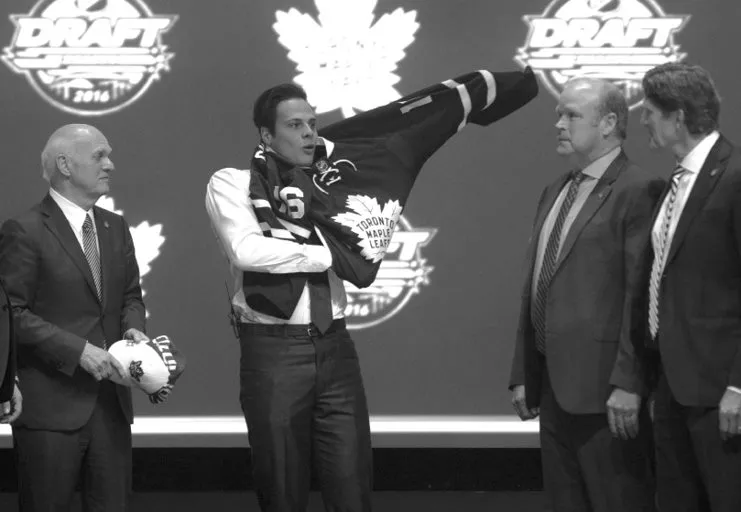
Left to right on stage for the Leafs’ historic 2016 draft moment: Lou Lamoriello, Auston Matthews, Mark Hunter, and Mike Babcock. (Nathan Denette/The Canadian Press via AP)
“It’s something that we do for all of our players but certainly I think when you’re a star player of a team, there are expectations and players put expectations on themselves. But if you’re going first overall, you don’t get drafted and then say, ‘Oh, expectations? That’s new. Pressure? That’s new.’ Guys like Wendel, guys like Auston, they’ve been dealing with pressure and expectations since they were little kids. But I think that any organization has to really believe that no matter where you stack up in the league or where you stack up in a team’s lineup, you help players, and you help them fulfill and meet or exceed their potential. And you try to give people all the support you can, so that they can have all of the success that they can. That goes for not just guys who go first overall, but for everyone.”
Shanahan also acknowledges that any number of things could have led the Leafs down a different path. Had they won just one more game that season, he points out that they would have leap-frogged the Oilers to finish 29th in the standings, and an identical drawing of the balls would have given Edmonton Connor McDavid and Auston Matthews for their fifth lottery win in seven years and the Leafs the fourth overall pick (which the Oilers used on Jesse Puljujarvi) for the second year in a row.
“When you’re in that position, you need a little luck to fall your way,” he said.
As for the lottery and the role it plays in determining that good and bad luck for teams? Shanahan says he has never been a strong proponent or opponent one way or the other in its designs.
“I don’t have a strong opinion on some of the tweaks that they’ve made to it. But the general concept that there is a lottery, and that even if you finish in last place there’s no guarantee that you draft first, I think is a fair one,” he said. “We went into that lottery with an 80 percent chance of not getting the first pick even though we finished in dead last. So I think there’s a certain integrity and fairness in that it’s not guaranteed. I don’t mind the draft lottery at all.”
Above all else, though, he acknowledges that the job didn’t end with that lottery win and Matthews. He knows that winning a Stanley Cup comes down to much more than that. But the two years that led to Matthews were a necessary means to an end, nonetheless.
“As much as you just wanted to figure out a way to win right away, we knew we probably needed to go the opposite direction for a little bit in order to come out the other end. And we’re still in that process,” Shanahan said.
Those two years also taught Shanahan and his staff that patience will pay off in that process. When failure followed at various points in the form of first-round defeats in 2017, 2018, 2019, 2020, 2021, and 2022, their lessons learned from time spent at the bottom helped them stick with their pursuit of the top.
“Our view was that if we had the patience and did this the right way with some trades, some free agents, player development, but most importantly and at the heart of it, find a way to draft core pieces—which we did at fourth overall and first overall—and build around them, then we could build something that was sustainable for a long period of time,” Shanahan finished. “That was, and still is, our goal. It’s even more relevant today than it was back when we planned the build. I believe in them.”