Appearance
13. How Tyler Biggs Led to Morgan Rielly and William Nylander
There is a danger for teams—in pro sports and in drafting—when what they think will make them successful begins to diverge from the reality of what actually will. And there is a danger for players—in pro sports and in drafting—when teenagers get caught up in that, crushed under the weight of expectations that are either misplaced or unattainable—or worse, both. Life under the microscope can burn when the light is bright. In Toronto, when that light focuses on you, it never lets you step back out of it. And in the history of the Maple Leafs, few have been burned by the weight of expectations and the disconnect of their team more than 2011 first-round pick Tyler Biggs.
Biggs was a tipping point for a Leafs team that thought it knew exactly what it was doing until it diverged far enough away from reality that everything caved in on them, leaving them (and eventually Brendan Shanahan) with no choice but to chart an entirely new course.
So what happened with Biggs and how did his selection get the Leafs back onto a better path at the draft—and, consequently, as an organization? Well, it comes down to a lot more than the words and language—first truculence and belligerence, then bust and failure—that his story became about.
* * *
On a phone call a decade after the Leafs infamously traded up to select Biggs 22nd overall in the 2011 NHL draft, Dave Poulin (now a broadcaster with TSN, then a senior member of the Leafs’ management group) is still trying to make sense of the layers of things that led to the decision—and eventually to the undoing of a promising young hockey player’s career.
He starts with the man in charge, though.
“Hey, Burkie [Leafs general manager Brian Burke] is a factor when Burkie’s your boss and you know the kinds of players he likes. And that’s still 2011, when Boston had won their Cup with a big, physical group and you were looking at what he could grow into. It was, ‘What could Tyler become at 6’3”, 220?’ And so you were projecting.”
There was the outcome, too. Biggs didn’t become just a player that the Leafs had drafted too high. He also became a player they’d traded two high picks for. And those two high picks had become Rickard Rakell, a two-time 30-goal scorer, and John Gibson, who became one of the league’s better starting goaltenders.
“He was hurt immensely because of a couple of players that went after him,” Poulin said. “It’s such a tough gig. As I think back and reflect over it, it’s just such an inexact science it’s unbelievable.”
Poulin saw things in Biggs that he’d seen in himself in his own playing days, too. He was an undrafted kid who developed a physical, lead-by-example game in college at Notre Dame and emerged to play 13 years in the NHL, including six as the captain of the Philadelphia Flyers, appearing as an All-Star twice and winning the 1987 Selke Trophy as the league’s best defensive forward.
There was also a familial connection that had drawn teams to Biggs through his father, Don. Don was raised in Mississauga, Ontario, and made a name for himself as a hated—and feared—forward with the Oshawa Generals in the OHL. In 1983, the Minnesota North Stars drafted him in the eighth round of the NHL draft. He played nearly two decades in the AHL and IHL before settling in Loveland, Ohio, where he played for the Cincinnati Cyclones, had his number retired, became a member of the AHL Hall of Fame, and raised Tyler.
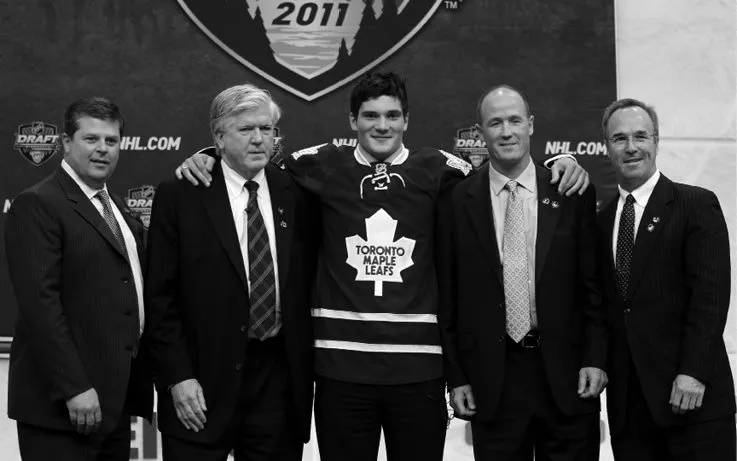
Left to right at the 2011 NHL Draft: Dave Nonis, Brian Burke, Tyler Biggs, Dave Morrison, and Dave Poulin. (AP Photo/Andy King)
There was more to it than a general manager who wrongly went after the thing he coveted, too. The Leafs weren’t the only team prepared to take Biggs in the first round. In his draft year, Biggs had made a name for himself as the mean, powerful captain of USA Hockey’s national development program. The Leafs’ scouts were all impressed by how good he’d looked when Team USA had played against college teams and his advanced physicality and athletic maturity had shone through. He’d also just come off an impressive showing at that year’s under-18 world championships in Crimmitschau, Germany, leading the Americans to gold (his second under-18 gold, after having played above his age group with Team USA the year prior).
He’d gone through an extensive recruitment process into college, too. You name the school—Notre Dame, Michigan, the rest—and there was interest in Biggs. He ultimately settled on the University of Miami–Ohio because of his local roots and because the team’s assistant coach, Chris Bergeron, had played a few years of minor pro with Don.
“The process was the high profile of high-profile schools,” Bergeron said.
Bergeron had known Biggs since he was a little kid who’d hang out around the rink, but he began recruiting him heavily in his Minor Midget season as a 15-year-old when he and Don moved to Toronto to play in the GTHL with the Jr. Canadiens in search of stiffer competition for him.
On initial visits to Toronto, Bergeron was blown away by Tyler’s play on the ice and how well-spoken and mature he appeared off it.
“He was such a big kid at a young age. He grew quickly and he was almost like a man child really young,” Bergeron said.
When Biggs scored 40 goals and 86 points in 72 games to finish seventh in the GTHL in scoring as a 15-year-old, he became such a commodity that Bergeron and the rest of the big college programs who were recruiting him feared he’d go the OHL route as a fast-track to the NHL. But after he went to the national program’s 40-man camp and was quickly told he had a place on the team if he wanted it, he accepted and the college path became the choice.
“He was a high-profile young person. He was a really impressive young man who was on this path to the NHL. Having Tyler Biggs commit to Miami at that time was a huge victory for Miami in terms of recruiting,” Bergeron said.
While Bergeron was digging into that recruiting battle, he was also pursuing another opportunity for himself to become a head coach at Bowling Green State University. So when he took the job for the 2010–11 season and Biggs showed up that fall for his freshman year at Miami, fresh off being selected by the Leafs in the first round, the coach who’d brought him there was gone.
Rico Blasi, who was then the team’s head coach, was still a big believer in Biggs, though, too. And he hoped that the feeling was still mutual.
“In the recruiting process, he was pretty excited to come to Miami. It was him playing at home in front of his family. So everything was great,” Blasi said. “He was a really good kid, very polite, worked hard, and then had a pretty decent year at the national team. But once he was drafted in the first round, I think you could see the expectation now that he was going to be what he had dreamt about being all his life.”
Biggs didn’t have a bad year for a true freshman by any standard, either. Blasi and his staff were actually really pleased with how he played. They used him on the penalty kill and the power play. They went to the national tournament, losing in overtime to end their season. His 17 points in 37 games ranked ninth among all under-19 players in college hockey.
“For me, he was great,” Blasi said. “He was a big part of what we were doing that year. He was a good kid, he worked hard, he played a really good role on our team. It was that simple.”
But without Bergeron, and without glossy numbers, staff at Miami worried that outside factors and actors had begun to heavily influence where Biggs and the Leafs felt he was at—and consequently, what came next for him.
“I thought he would stay at least two or three years, kind of like some of the players we’d had in the past who ended up making pretty good names for themselves playing in the NHL or at least earning an opportunity. But I think some of the expectations and pressure that came along with being a first rounder kind of skewed some of his decision-making,” Blasi said. “I think that’s a real thing that a lot of people don’t talk about. Some first-rounders, they get an opportunity to play pro and they kind of get gobbled up in it. I don’t think it was all the time that Tyler let himself get wrapped up in it. During the week in practices and games, he was just about playing. But I think maybe in moments where he was watching games, or talking to whoever he was talking to, he felt the pressure of being a first rounder and was constantly thinking, ‘Where am I going to be next?’ A lot of those guys get caught up trying to be NHLers too fast.”
As Biggs tried to navigate all of that, Jeff Twohey, an old opponent of Don’s in their OHL days who’d just taken over as general manager of the Generals (the OHL team that owned Biggs’ rights after having drafted him back in 2009), called Don to express interest in bringing Tyler to Oshawa, where Don had coincidentally played three years of his own junior career.
When the Leafs committed to an entry level contract if he decided to leave college, Biggs, under pressure from several sides and now the lure of NHL money, decided to leave after his freshman year—“on good terms,” according to Blasi—and join the Generals, less than an hour east of Toronto, to play under Twohey and coaches D.J. Smith and Paul McFarland (both of whom coincidentally also went on to coach with the Leafs).
The following season, in Oshawa, the feelings among the Generals staff about Biggs mirrored those of the coaches in Miami. They liked him. They used him on both special teams and slotted him alongside star Boone Jenner. But when his production continued to fall below expectations, and when it happened in front of Leafs staff like Poulin, Burke, and then director of player development Jim Hughes, who attended most of Biggs’ games, the pressure he put on himself—and others placed on him—continued to pile up. As it did, Generals staff began to feel like Biggs, who they knew as a personable kid, had withdrawn himself from his teammates. By playoff time, when he knew he would leave the Generals for the AHL at year’s end, they watched as his play, which they also knew to be all-in, began to step out the door. When they lost, and he left, they never heard from him again.
* * *
After Oshawa, Biggs struggled to find a role with the Marlies and the Marlies struggled with how—and where—to deploy him in their lineup. The rest unravelled quickly, and within a few years he was no longer a member of the Maple Leafs organization. He’d bounced between the AHL and the ECHL and he’d spent half a season in England. By the summer of 2019, at the age of 26, he was out of pro hockey.
All these years removed from Burke’s bold draft floor move in Minnesota, those who played a role in Biggs’ development feel as if they share in how things went.
Bergeron, who bumped into Don at a game between Miami and Bowling Green a few years back, isn’t quite sure where it went wrong, but wishes he’d been there to help guide Biggs through that freshman year.
“I don’t know what happened. I just don’t know. But it’s one of those things that I’ve been through a couple of times in my career, and I did feel bad that I was the pivot on the recruiting with Tyler and his dad, and then I walk away and it was almost like the guy that drafted you wasn’t there anymore,” Bergeron said. “And I’m not saying Rico didn’t like Tyler’s game, because he did, but the relationship that was built between him and Miami, I was the bridge for that and then I wasn’t there. And I don’t want that to sound selfish because it’s not about me, it’s about the boy, but you just don’t know. When adversity hit, the guy that he had the relationship with wasn’t there. Did that have something to do with it? I can’t be sure. But when I look back on it, that’s something that I wish I would have had a chance to coach that boy.”
He also wonders whether, had he been there, Biggs would have stayed for an extra year or two.
“I’m a firm believer that every kid, whether it’s first-rounders, seventh-rounders, or free agents, no kid can ever be too prepared. So to me, another year or two in college, you can never go wrong with that,” Bergeron said.
When Blasi bumped into Biggs while out for dinner one recent summer, they gave each other a huge hug. He, too, left that interaction wondering what could have been.
“I certainly saw the expectation. I mean, he was 6’3”, he had a great shot, he could skate, he had a pretty decent year when he left us, he won a gold medal on the world juniors team, so things were moving in a good direction for him even briefly after he left us. I thought he got better with us, too. Selfishly, as a coach, I would have loved to have had my hands on him for a couple more years just to mature him a little bit, not just his game but emotionally and intellectually like we do with all of our players at the college level,” Blasi said, pausing. “But in any event, I thought he was headed in the right direction. I thought he had some upside. Obviously at that point it’s up to what he’s going to do on a daily basis, and then there’s also got to be some luck in terms of the opportunity that comes. I still care about him. He was a part of our family. I think it was just ‘I want to get there’ and ‘I want to see how far I can take this.’ And when you’re a first-rounder, you’ve got a lot of different influences that are coming in.”
Poulin wonders how things would have been different had the Leafs drafted their other favourites in that slot: Jenner, Brandon Saad, and Vincent Trocheck, all of whom became impactful NHL forwards.
Leafs skating coach Barb Underhill felt that Jenner, after bringing him in for a pre-draft skate, could pick up a step and turn into something. The rest of the Leafs staff had spent a lot of time in Saginaw watching Saad and Trochek, but “both had some baggage coming in” that Biggs didn’t, according to Poulin.
“You look back at that draft now and part of the process is considering who you didn’t take and why you didn’t take them and how personal it is for the scouts that are involved,” Poulin said.
Biggs wasn’t even the only player he wishes the Leafs got more out of from 2011, either.
Poulin says he’s still “baffled” that Stuart Percy, who they took just three slots after Biggs with another first-rounder in 2011, didn’t turn into a full-time NHL defencemen. When the Red Wings traded the 24th pick to move back to No. 35, the Leafs knew that they were doing it because they thought they could get Percy a little further down. Then the Leafs decided to pounce with their No. 25 pick.
“He was such a cerebral player, but he was a quarter of a step slow. And the Red Wings were really high on him because they had a pretty cerebral defenceman there that played the left side who was going to be retiring by the name of Nik Lidstrom,” Poulin said, laughing. “Those Detroit guys told me they were comparing his game to Nik. Like that’s how smart they thought Percy was. And then he stepped into the NHL and basically played right away, and it was like, ‘Oh, jeez, this kid’s going to be just fine, he just needs another quarter of a step.’ But he never picked up that step.”
Poulin can’t help but wonder whether things would have turned out differently for Biggs had he not landed in Toronto, too. Both the Washington Capitals (who began the draft with the 26th pick) and the Phoenix Coyotes (who nearly drafted Biggs 20th overall) had been blown away by him throughout the interview process.
The Coyotes were wowed by Biggs in a Team USA game against the University of North Dakota, where the rest of his teammates were completely outmatched and he was the only player who could handle it. They were further impressed at the combine by his fitness levels and the way he spoke, regaling them with his interest in the military.
“Man, that guy’s got character,” was a common refrain about Biggs among NHL teams during those combine meetings in Toronto in advance of the 2011 draft.
George McPhee, who was then the general manager of the Capitals, told Bergeron that he could count on one hand the number of kids who’d “made an impression on him as a young man as much as Tyler did.”
So Bergeron’s not surprised the Leafs fell in love with Biggs.
“In the world we live in, we’re taking a chance on a human being maybe more than we are the hockey player. And when you’re taking a chance on people, those are more calculated risks as far as I’m concerned,” Bergeron said.
When he was a recruiter and coach at Notre Dame, Poulin saw firsthand the role environments played in the success of players.
“Kids get in the right environment and just absolutely thrive. And that’s up to the team, to create the right environment. And we were doing more and more of that. I was running the Marlies at the time, and the focus was to get the right mix of people. And my last three years with the Marlies, we played nine playoff rounds in three years and lost in the finals. So we were putting the kids in the right environment from that standpoint. But I do think Tyler left college too early, even though I watched him play with Boone Jenner in Oshawa and it was like, ‘Oh, this is great,’” Poulin said.
These days, though, none of those what-ifs matter to Biggs anymore. When his hockey career was done, he started over, trained at the Divers Institute of Technology in Seattle, and became a diver for Subsea Global Solutions, a commercial diving company specializing in underwater repairs and maintenance.
But for the Leafs, the effects of his selection lingered long after he was gone. They lingered in the first-round draft pick they used on him and got no NHL games out of, the draft capital they spent to move up to acquire him, and the tarnishing impact both of those things had on how the Leafs brass of the day did business—and scouting.
A year and a half after the Leafs drafted Biggs, Burke was fired. A year and a half after that, Poulin was fired on the same day the Leafs hired 28-year-old Kyle Dubas as their new general manager. Many within the Leafs’ scouting department soon followed.
And the organization’s path diverged once more, this time in a completely different direction.
* * *
In the years after the Leafs moved up to draft Biggs, their scouts were directed to look for—and covet—different things. Although the proverbial page didn’t flip in an instant (they drafted centre Frederik Gauthier 21st overall for his size and defensive aptitude just two years later), progress began to be made for a team that had for so long struggled to find more than role players in the draft.
That began in earnest at the 2012 draft, when the Leafs, in a greater effort to use their wide-ranging resources, decided to focus on some perceived market inefficiencies. One of them became Sweden and the decision to give the team’s most prolific area scout, Thommie Bergman, carte blanche with one pick a year. Those picks became Viktor Loov (a 2012 seventh-rounder who came close to making it before moving to the KHL), Andreas Johnsson (a 2013 seventh-round pick who became a versatile everyday NHL forward), and, in 2014, two more players: would-be star William Nylander, drafted eighth overall, and would-be bottom-six forward Pierre Engvall, drafted 180 picks later. “He basically got the last pick in the draft,” Poulin said of Bergman, laughing.
More focus was also placed on spending time scouting overaged players, a decision that produced the 2012 sixth-round selection of late-blooming Erie Otters winger Connor Brown, who went on to become a 20-goal scorer in both Toronto and Ottawa.
But the first big success of the Leafs’ new approach and the value it sought to exploit came with their first pick of the 2012 draft in Pittsburgh, when they selected Moose Jaw Warriors defenceman Morgan Rielly with the fifth overall selection. Rielly had just missed almost his entire draft year due to knee surgery but the Leafs, after falling in love with his game at the under-18 world championships, had made sure to do their due diligence.
When the draft rolled around, they knew that his teammates in Moose Jaw had gravitated toward his personality, even when he was a rookie, and that they’d taken to referring to him as “The Chosen One” for his natural athletic gifts, his advanced physical maturity, and his ability to go end-to-end. They knew, in talking with Dave Hunchak, the Warriors’ head coach during Rielly’s rookie season (who was replaced for his draft year), that so long as the knee injury didn’t linger, Rielly’s skating was, as the coach described it, “second to none.” They knew, through discussions with long time Warriors general manager Alan Millar, assistant coach Mark O’Leary, and Rielly’s billets, the Wattersons, the lengths he’d gone to in his draft year to get back on the ice ahead of schedule during the playoffs, getting back into the gym just days after his surgery. They knew about the regular phone calls he’d make to O’Leary on off-days, and the one time he showed up at the team’s hotel in Medicine Hat at 3 am during the playoffs, when he still wasn’t travelling with the team, to support them. And they knew about the long hours he spent in the gym, when the rink was empty, building himself back up, blazing through a rehab unlike any player Millar and his staff had ever seen. Millar insisted in conversations with the Leafs that Rielly was special both on and off the ice. Poulin, who played with Mike Stothers (who took over as Warriors head coach in Rielly’s draft year) in Philadelphia, also leaned on that connection while head amateur scout Dave Morrison and his team worked to “look past the injury” in their evaluations and projections.
Late in the draft process, Poulin and Morrison then made the decision to organize family visits with two players. The first was with Russian American centre Alex Galchenyuk, a visit Poulin said went well.
The second was to the Rielly family home in North Vancouver to spend some time with him and meet his parents, Andy and Shirley, and his brother, Connor.
Immediately, Poulin noticed how the socioeconomic background Rielly came from was different from most other elite-level hockey players he’d visited over the years.
“I remember pulling up to some houses while recruiting for Notre Dame or the Leafs and thinking, ‘Holy shit, how is this kid going to be motivated to play hockey?’ But if you saw Morgan Rielly’s house, built into the side of the hill in West Vancouver, you’d be looking over at Mo thinking, ‘Oh, boy, you got a totally different experience from that.’”
By the time the meeting was over, Poulin and Morrison both agreed that it cemented him as their guy.
That was further solidified at the scouting combine in Toronto that June, a few weeks before the draft, when the team’s interview with one of the draft’s other presumptive top picks, Nail Yakupov, went so poorly that, according to multiple people in the meeting, Leafs scout John Lilley “came right over the table” at Yakupov when he answered one of general manager Brian Burke’s questions by dismissively blowing and saying, “That’s not a question.”
“That’s the boss; if he asks you a question, that’s the question!” Lilley shouted back at Yakupov. “You don’t decide what the questions are!”
When the interview was done, Poulin, Morrison, and Leafs scout Garth Malarchuk even took Yakupov out to dinner to say, “Look, that didn’t go well,” and give him a chance to explain himself, only to come away still feeling uncomfortable about him.
By the time draft day in Pittsburgh arrived, the Leafs had Rielly ranked first on their board.
They also felt they knew what three of the four teams in front of them were going to do, intel that left them confident in the odds that Rielly would be available at No. 5. They believed, as the rest of the hockey world did, that the Oilers would take defenceman Ryan Murray after Kevin Lowe, Edmonton’s president of hockey operations and the general manager of that spring’s Team Canada, had taken him to the World Championships to preview and get to know him. They knew that the Blue Jackets were likely to follow with Yakupov. And they knew that the Canadiens were partial to Alex Galchenyuk thanks to information from Habs assistant general manager Rick Dudley, who’d left his role as director of player personnel with the Leafs just a month before the draft.
“Rick had worked with us all year and knew our list and had an opportunity to go to Montreal before the draft, and he went on the handshake that he wouldn’t be involved in the first round,” Poulin said. “And to Dudley’s credit, he knew we loved Morgan and there’s a reason he’s been in the NHL as long as [he has] from a trust standpoint. So I fully assumed, having never had to ask that question, that he wasn’t involved in the Galchenyuk pick.”
The Islanders, who held the fourth pick in the draft, were, they felt, the only wild card. If they took Rielly, defenceman Hampus Lindholm was going to be the Leafs’ guy. But when they drafted defenceman Griffin Reinhart instead, the Leafs felt confident in their due diligence on Rielly, and they didn’t hesitate in taking him.
* * *
Though the Rielly pick was the start of a new chapter for a beleaguered Leafs franchise, it was two years later, after Burke was let go and his lieutenant and replacement, Dave Nonis, was charged with making the team’s eighth overall selection in the 2014 NHL draft, that the team’s new course was put to the test.
All year long, a player the old Leafs would have coveted, 6’2”, 226-pound power forward Nick Ritchie—a kid in the Biggs mould who grew up playing for the AAA Toronto Marlies—played just a couple hours north of Toronto in Peterborough, notching 39 goals, 74 points, and 136 penalty minutes in 61 games for the OHL’s Petes.
So in the lead-up to the draft when Ritchie, who disgruntled Leafs fans and media alike expected the Leafs to take right up until the pick was made in Philadelphia and he was still available, wasn’t even the Leafs’ first, second, third, or fourth option, it sent a clear message internally—and eventually externally when he wasn’t their pick—that times were changing.
Bergman, under this new post-Burke leadership, pushed hard for Nylander.
“Thommie felt that William was potentially the most skilled player in that draft. He was on record saying that and we were on record saying that, just from a pure skill standpoint,” Poulin said. “And there’s a reason he got those late picks. And I don’t think anyone expected [Oilers superstar and the third overall pick] Leon Draisaitl to be Leon Draisaitl. No one. No one. No one thought he was going on his way to a Hart Trophy or anything like that.”
Others argued on behalf of highly skilled QMJHL import Nikolaj Ehlers. And though the debate came down to Nylander and Ehlers in the end, the Leafs preferred Czech winger Jakub Vrana and Swiss winger Kevin Fiala, all also “skilled kids first,” to Ritchie, too. They even circled David Pastrnak, who became one of the draft’s top NHL players and was Nylander’s close friend and teammate with Södertälje SK in Sweden, as a target if they were to trade back (or trade up to acquire a second first rounder).
They also knew that the way Nylander had bounced around from team to team in his draft year made him harder to scout and raised questions about his motivation for those moves—questions which were heightened by the come-and-go reputation his dad, Michael, had during his own NHL career.
“Michael had played for so many different teams and had had different experiences with different people through those years, and then you also had the Shanahan factor, which came into play there. Shanahan had joined the group and had played with Michael at some point. So you had that in there as well.”
The Leafs did their research, only to resolve that the moves had nothing to do with his play or his attitude. (In fact, one of the five moves he made in 2013–14 was to play with his dad in Angelholm with Rogle BK.)
“He was all over the place. I mean, it was crazy. And it was like, ‘Is that good, is that bad, what is that?’” Poulin said. “He was in Sodertalje playing with Pastrnak, and then he was in MODO, and then he was back in Sodertalje, and then he was in Rogle.”
Coincidentally, two of the places he had spent some time playing hockey were also connections that Poulin shared with him. The first was in Angelholm with Rogle, where Poulin had played before he broke into the NHL. The second was at Notre Dame, Poulin’s alma mater. Nylander had skated and trained in the summer at Notre Dame under Andy Slaggert, the team’s associate head coach of three decades, and had developed a bond with Slaggert’s three hockey-playing kids, Graham, Landon, and Carter.
“Andy kept telling me how great a kid he was, and we just kept coming back to William,” Poulin said. “And the allure of Ehlers was he was playing in Halifax, so he had already adjusted to the North American game, but even on that front William is about as North American as you can possibly get after growing up bouncing around the NHL with his dad.”
The Leafs’ bet on Nylander paid off, too. The following season, he exploded in the SHL, spending the first half playing to a point per game with MODO, torching the world juniors, starring for the Marlies in the AHL as a teenager down the stretch, and leaving no doubt about his future NHL potential.
And after years—nay, decades—of blowing the picks that mattered most for all the wrong reasons, the Leafs learned from their Biggs mistake. And now they had Rielly and Nylander, and the skill they needed to build upon for their next, decidedly different, chapter.
They’d gotten two right.
“[In 2012], we really did have Rielly at the top of that list. And I know Burkie said that at the end of the draft, and Burkie’s Burkie, but that was the truth,” Poulin said. “[And in 2014], it really did come down to William and Nikolaj and the skill. And you know what, you might still have the argument [about Nylander and Ehlers] today, but us having the debate between those two guys was a good sign. It was progress.”