Appearance
6. Toronto’s First Draft…and First No. 1 Pick
After the NHL draft went public in 1980, it was only a matter of time until it left Montreal for the first time, too. In 1984, in its fifth straight year at the Montreal Forum, the draft was broadcast live for the first time when the Canadian Broadcasting Corporation (CBC) aired it in both English and French to a Canada-only audience.
A year later, when the draft began its since-familiar circuit around the league to new host cities each June, the 1985 NHL draft marked a pair of firsts for the Maple Leafs. Not only did they get to host for the first time, welcoming 7,000 fans into the Metro Toronto Convention Centre (conveniently located just down the street from the CBC’s studios) for the one-day event, but it was also the first time in the draft’s then-23-year history that the Leafs were set to pick first overall. The slotting came after they ended the 1984–85 season in last place in the 21-team league, winning just 20 of 80 games to finish with 48 points (five fewer than the next-worst Penguins).
In the audience sat a 5’11”, tough-as-nails defenceman from Kelvington, Saskatchewan. He was wearing a tan suit and navy-blue pants, his sandy blond mullet tucked long behind his ears and matched by an unmistakable, thick mustache.
His name was Wendel Clark.
* * *
Clark arrived at the 1985 draft by way of a blue-collar hockey upbringing that informed the player he’d become. That upbringing started on the Clark family’s cattle and grain farm just outside of Kelvington, a rural town of fewer than 1,000 people—where his father, Les, was also born—located more than two and a half hours east of Saskatoon. He was born in 1966 as the middle of three Clark boys to older brother Donn (born in 1962) and younger brother Kerry (born in 1968).
Hockey ran in the blood, the water, and everything else. Kerry became a 10th-round pick of the Islanders in 1986 and racked up 2,812 penalty minutes in 10 seasons split between the minor league AHL and IHL. After four seasons as an in-and-out-of-the-lineup type in the WHL, Donn spent 17 seasons on the other side of the sport as a head coach and general manager in the league, leading the Prince Albert Raiders and Saskatoon Blades in the 1990s and 2000s. Several sets of the Clark family’s cousins were also born and raised in Kelvington and went on to have careers in hockey. Wendel’s uncle, Jim Melrose, ran the local rink and raised one of his children, Barry, to become a second-round pick of the Montreal Canadiens (and a Leaf for three seasons in the early 1980s). On the other side of the family, two different sets of Kelvington’s Kocur family raised Wendel’s cousins Joey (a fifth-round pick of the Red Wings in 1983 who won three Stanley Cups with the team) and Kory (a first-round pick of the Red Wings in 1988 who never made it to the NHL).
In time, Wendel came to eclipse each of them.
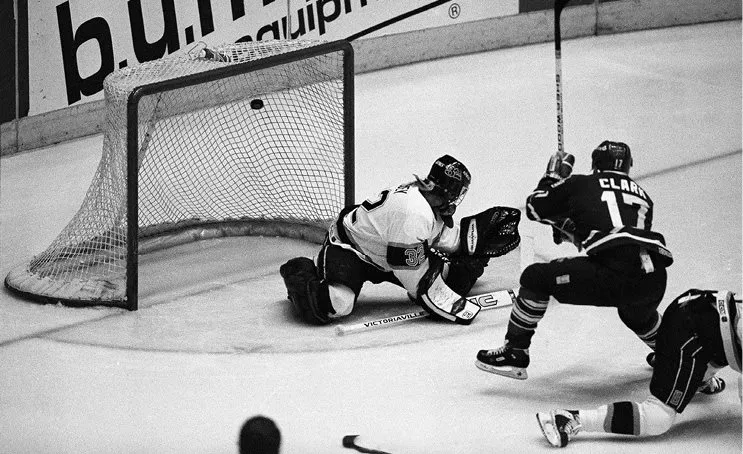
Wendel Clark was a man of firsts for the Leafs—their first No. 1 overall pick. The first pick of the first draft held in Toronto. And eventually, he was traded for another first overall pick: Mats Sundin. (AP Photo/Mark J. Terrill)
First there was AAA hockey in Yorkton, 150 kilometres south of Kelvington, at age 13 and 14, which required leaving directly from school and not returning home until after midnight just to attend practices. Then there was the Notre Dame Hounds AAA team in Wilcox, a further three hours south of Kelvington, at age 15 and 16. And by the time he’d followed in Kerry and Donn’s footsteps to the Saskatoon Blades in the WHL, Wendel was destined for somewhere they never were—the NHL.
As a kid and young teenager, though, Wendel’s sights were never really set on the NHL. Things only began to change around Christmas of his first season in Saskatoon when he found out that he was ranked by NHL Central Scouting. When the calendar changed from 1983 to 1984, Wendel began fielding calls and in-person meetings with NHL clubs every second day in the New Year. And when his rookie year was over, he’d posted 68 points and 225 penalty minutes in 72 games, stamping his mythic heart-on-his-sleeve style.
Early on in Wendel’s sophomore season, his agent, Norm Caplan, passed suddenly of a heart attack in late October. Instead of signing on with another agent, he elected to play out the year, his draft year, without representation so that he could focus on his play.
“I just played and stayed out of the politics of it,” a 54-year-old Clark said with his typical succinctness on a phone call in the spring of 2021.
His strategy worked when he registered a further 93 points and racked up another 260 penalty minutes in a combined 67 games between the regular season and the playoffs to finish second on the team in scoring, first in penalty minutes, and among the league’s leaders in both categories for a defenceman. He also represented Canada at the 1985 World Juniors in Helsinki and Turku, Finland, scoring three goals and five points in seven games en route to a gold medal win over Czechoslovakia. Eventually, when his draft year was done and his Blades had been swept in three games by the Regina Pats in the first round of the 1985 WHL playoffs, Wendel joined agent Don Meehan and his Newport Sports Management (which he’d started four years earlier and today represents more than 100 NHL players). In the run-up to the draft, though he knew he would likely be picked inside the top three, Wendel had no idea whether he’d be picked first.
As he made his way down through the crowd and was handed his Maple Leafs jersey by Leafs staffer Gord Stellick, sportscaster Don Wittman greeted him at the draft floor to interview him as he walked toward the Leafs’ draft table.
Clark answered Wittman’s questions curtly and almost nonchalantly, a sign of things to come in the way he would carry himself through the rest of his career in Toronto.
“What do you think you’ll be able to add to the Toronto Maple Leafs?”
“I just hope to do my best and hope to help the club,” Clark said as they arrived at the table, removing his jacket and pulling his new jersey over his head.
On the broadcast, the team assembled in Toronto to cover the event responded with a bit of surprise, believing the Leafs would take defenceman Dana Murzyn.
More than three and a half decades later, Clark confesses he didn’t know he’d be their pick either.
“The Leafs didn’t tip their hand, or they didn’t tip it to me at all. But boy was it neat to get picked first overall, and at the draft in Toronto,” Wendel said of the eventual name-call, describing a blur of tables, fan excitement, and frenzied interview stops.
His memories of the days that followed come into focus a little clearer because the next thing he knew he was leaving the province he’d called home his entire life to move to Scarborough, bordering Toronto’s east end, and bunk in with the parents of Peter Zezel, another of Meehan’s clients who no longer lived at home and was entering his second season with the Flyers.
Then, on his first day of camp, Wendel arrived to a surprise.
“I read my name on the door and it said, ‘left wing, Wendel Clark.’ That’s how it started. As simple as that,” he said with a chuckle of the move from defence to forward, a move he’d briefly made with Team Canada at the world juniors because it was the only way he’d make the team but not one he expected to make in the NHL.
Nonetheless, Wendel became a shot in the arm for a team that sorely needed one. He turned 19 at the end of October, a few weeks into his rookie season, went to the All-Star game (his first of two career appearances), and led the Leafs in goals (34) and penalty minutes (227). At Maple Leaf Gardens, he quickly became a fan favourite as a teenager, a bond that he says began to form on day one with his new team.
“A lot of me starting to get the fans on my side probably started with the draft because it was in Toronto. You had a relationship that kicked off in June before the season started,” Wendel said. “And the style of game that people liked wasn’t any different whether you were in junior or the NHL. I played the same style I’d played at every level. That was an exciting style for a fan to watch.”
With Wendel always in the thick of things, the Leafs took a modest step forward, finishing fourth in the five-team Norris Division (which was still one of their worst records as a franchise to that point) before stunning the top-seeded Blackhawks with a first-round sweep and falling to the Blues in a tightly-contested seven-game series in the second round. Clark scored five goals and added 47 minutes in the box across their 10 games. When it was over, he finished second in Calder Trophy voting for the league’s rookie of the year.
The following season, as a sophomore, he was named an assistant captain before his 20th birthday. Five years after that, he became the Original Six franchise’s 14th captain. Though a cross-check to the back against the Blackhawks in 1987 left him hobbled for much of the rest of his storied career, Wendel remained the favourite of the Maple Leaf Gardens crowd into the early 1990s, playing the first nine years of his NHL career in Toronto. In 1992–93, he led the Leafs to a then record 44 wins and 99 points before infamously losing to Wayne Gretzky’s Kings, coached by none other than his cousin Barry Melrose, in the Clarence Campbell Conference Finals. His playoff performance that year lives on as one of the Leafs’ all-time greats, with 20 points in 21 games and a hat trick in Game 6 in Los Angeles. The following year, in the last of those nine seasons and despite continued injury troubles, Clark scored 55 goals split between 82 regular season and playoff games, a run of play that remains one of the most prolific in franchise history.
That summer, at the 1994 NHL draft, he was dealt to the Quebec Nordiques as part of the blockbuster trade that brought another first overall pick, Mats Sundin, to Toronto. The Leafs never could really get rid of him, though. He was traded back to the team at the 1996 trade deadline with Islanders teammate Mathieu Schneider and prospect D.J. Smith (who two decades later became an assistant coach of the Leafs for four seasons) in exchange for journeymen Darby Hendrickson, Kenny Jonsson, Sean Haggerty, and the Leafs’ 1997 first-round pick (which became a fourth overall pick and was used by the Islanders to select future star goalie Roberto Luongo). After spending two more seasons with the Leafs and signing with the Tampa Bay Lightning in the 1998 off-season, Wendel was later released by the Blackhawks in January 2000 and signed to return to the Leafs for a third time in the twilight of his career. In the postseason of that year, he captured the Leafs faithful once more, this time in their new home at the Air Canada Centre, prompting a series of standing ovations en route to a second-round defeat to the eventual Stanley Cup–winning Devils before retiring at age 34.
He finished his Leafs career with 441 points in 608 regular season games and another 61 points in 79 playoff games. In 2008, Clark’s No. 17 was raised to the rafters in a November ceremony at the Air Canada Centre. In 2016, it was formally retired in an October ceremony that saw all the Leafs’ other previously honoured numbers retired alongside his. In 2017, the Leafs honoured him once more in a teary-eyed unveiling of his statute (one of just 14) on Legends Row in Maple Leaf Square, at the arena’s southwest corner. Since the end of his playing days, Wendel has remained a staple of the Leafs’ alumni box at home games and on the ice in alumni games as a community ambassador.
Even through some of the organization’s most trying years, Wendel never resented being picked first overall or anything that came with it.
“It’s no pressure. That’s what you’ve dreamed of your whole life. I don’t consider that pressure. Especially your first year, you’re 18 years old, you’ve basically just left high school, and now you’re in the NHL,” Wendel said. “The whole first year is kind of a blur anyways because there [are] no bad days. You can get injured, and it’s a bump in the road, but you’re playing in the NHL as a teenager. Whether you have a good season or a bad season, you didn’t know how good you were going to be at the highest level anyway. That’s my take on it. I simplify it right down to that.”
When he reflects on his days on the ice with the Leafs, a couple of things stick with him. The first, he argues, is that some of his teams were better than they get credit for.
“It wasn’t evident in the points, but talent-wise that team from 1985 to 1987 had as much skill and talent as the team in 1993. But [it wasn’t] put together yet,” he’ll tell you.
The second is all those special nights at the Gardens (as a Leaf and an opponent) before the Leafs’ 67-year tradition in the iconic arena ended in February 1999.
“Visiting teams couldn’t wait to play in Toronto in those days. And Toronto was the hardest home team to be because there were always half a dozen players on the other team from Ontario who loved coming home to play,” Wendel said. “The Gardens, in that era, Gretzky coming in with the best team ever, [Dale] Hawerchuk coming in as a Toronto guy who always had 100-plus points, there was always, in those high-scoring years, big guys coming in to try to have a big night on national TV with all of their buddies in the stands. That was the best.”
But these days, as he watches the Leafs’ second first overall pick, Auston Matthews, make new history of his own in Toronto, Wendel still scoffs at the idea that the gig is some kind of a burden.
“The Matthews, the [Mitch] Marners, the [William] Nylanders, when people say, ‘Oh, there’s all this pressure,’ I don’t think that’s pressure,” he said.
For a while, when he and Matthews bumped into each other around the rink, Wendel viewed him as a kid and tried to impart him with advice however he could. Now, whenever they see each other, Wendel sees Matthews as an adult and guidance makes way for laughs. He has cherished watching Matthews find himself in the spotlight, just like he eventually did in Toronto. He remembers when Matthews first arrived, the smiling, soft, easygoing look he always had on his face on the bench, and the way it juxtaposed the coach’s intensity behind him. It was the same look he remembers he and teammate Russ Courtnall had in their early days as the Leafs’ young stars in the mid-1980s.
“You’d look at their faces and you could tell he and Mitch were still teenagers. And as they’ve matured now, they carry themselves differently and you can tell their focus has shifted on the bench. And that’s just learning it as you play. You can’t get told. It’s how you pick it up,” Wendel said. “Auston has learnt by watching other players.”
Some of that maturity is physical, the kind that comes with age and muscle, too. Wendel always had to play bigger than he was to compensate for his size and scrap for his ice. Matthews, he thinks, shied away from that early on. Not anymore.
“When he first came in, he couldn’t outmuscle you even though he looked big at 6’3”. That happens at 22, 23. It’s tough for an 18-year-old to be good in an 82-game schedule against men. So then you go, ‘How come he had a bad week?’ and it’s not because he’s hurt per se, but he is under the weather, he’s tired. And he can’t even tell you that because he’s never been through it before,” Wendel said. “The first couple of years he was beating you on skill. Now he can beat you on skill and strength. Now he’s a hard guy to handle if you’re a defenceman.”
Wendel has been through the draft process twice now, as well. In 2018, his son Kody proved that maybe it was the Clark blood more than the Kelvington water when he was selected 47th overall by the Capitals out of the OHL’s Ottawa 67’s. Before the 67’s, Wendel coached Kody’s AAA Toronto Nationals in the GTHL. Growing up, he often told Kody the same thing he told himself about staying out of hockey’s politics. He played the parents of Kody’s teammates as straight as he did his teammates and opponents as a player.
“Just play. You can’t do anything about the outside,” he’d always tell anyone who’d listen.
That, he thinks, is getting harder and harder for the sport’s kids and their families to do in today’s NHL draft landscape.
“Everybody thinks you’ve got to lobby to do this and that, in the Toronto area especially. I say to people, ‘Hey, I went first overall and my second-to-last game in junior we lost 18–3.’ You’re not getting judged for that. However many shifts you’re getting, you just have to play your best. And they don’t understand it, and the parents don’t,” Wendel said. “If you’re a professional scout watching it, you’re watching for details that the parents aren’t and don’t understand what they’re looking for. The NHL game has nothing to do with junior hockey or minor hockey. It’s another thing.”
Kody, he insists, was the perfect case study in how the draft has changed in those ways—and how much harder it has become to project from one level to the next.
“We all see players that come along who were average in junior and really good professionals. Kody never hit puberty until 19. He was a 5’8” starting junior and he’s 6’2” now. So you get drafted at 18 but I tell parents that only the phenoms, only the Matthews and the Marners and Nylanders make it. The rest of the NHL doesn’t make it until they’re 23,” Wendel finished. “And more today than in my day.”
You won’t find first overall picks without agents these days. You won’t see first overall picks changing positions in their rookie season these days, either.