Appearance
1. Jim Gregory’s Draft Legacy
One of David Gregory’s earliest memories is of the day his dad, Jim, became the general manager of the Maple Leafs. It was the fall of 1969, and David was starting third grade at St. Richard Catholic School in Scarborough, Ontario, when his teacher pulled him aside to ask him about it—and, in turn, explain it to him.
More than five decades after that moment, hockey fans are most likely to recognize Jim’s name for his role as the man who for decades stepped up to podiums as the master of ceremony for Day 2 of the NHL Entry Draft.
But there is no history of the NHL draft, nor of the Leafs, without him. Jim’s legacy is the draft, and his hockey story started in Toronto before it ever existed.
The inaugural NHL draft (at first known as the NHL Amateur Draft) didn’t take place until 1963, nearly 60 years into the league’s life. For much of the first half of the NHL’s history to date, the league’s Original Six teams developed most of their would-be players themselves, often owning, operating, and sponsoring the junior hockey clubs that fed into the NHL.
In 1952, when a 17-year-old Jim moved from Dunville, Ontario, to Toronto to attend St. Michael’s College School, the Leafs sponsored two teams, the St. Michael’s Majors and the Toronto Marlborough Athletic Club, commonly known as the Marlboros, which both played in the Ontario Hockey Association (OHA).
Jim hoped to make the Majors’ Junior B team. When he was cut by the team, Father David Bauer, the school’s legendary teacher, hockey coach, and manager, prodded him to help out with the Junior A club as a trainer and stat keeper. Within a few years of his graduation from the school, Jim had become the Majors’ everyman, all but operating the team on his own on a $68-per-week salary. Father Bauer had become his biggest mentor in life. In 1959, Bauer leveraged his NHL connections to get Jim an interview with Leafs owner Stafford Smythe, an interview that led to his hiring as a part-time scout for the Leafs and summer employee at the Smythe family’s sand and gravel pits, roles he had to fill alongside his jobs with the Majors.
Two years later, in 1961, Jim was serving as general manager of the Majors within the Leafs’ farm system, and they won the Memorial Cup under his guidance.
A season after that Memorial Cup win, when the Majors withdrew from the OHA’s top junior league due to the impact its busy schedule was having on the athletes’ academic performance, Jim and many of his players were moved to the Toronto Neil McNeil High School Maroons for a single season in the Metro Junior A League. There, as head coach and general manager, Jim led the Maroons to a league championship and the finals of the J. Ross Robertson Cup (a trophy still handed out in today’s Ontario Hockey League). In 1963, when the Maroons were amalgamated with the Marlboros to stabilize the Leafs’ farm system, Jim was retained as head coach once more, guiding the Marlboros to his second Memorial Cup in his first season with his new team and a third in 1967 as the team’s general manager.
So by the time Jim was named Maple Leafs general manager for the 1968–69 season, he had already shaped the generation of hockey players he was taking over leadership of. Though he was just 33 years old and the league’s youngest general manager, Jim had helped develop future NHL players like Gerry Cheevers, Gary Smith, Pete Stemkowski, Ron Ellis, Gerry Meehan, and Mike Corrigan, among others, with the Majors, Maroons, and Marlboros.
Among Jim’s first orders of business when Smythe and co-owner Harold Ballard promoted him from assistant general manager to general manager to replace the fired Punch Imlach was to build the team’s first dedicated scouting department, hiring five full-time scouts. Throughout his tenure, he also paved the way for new avenues for NHL clubs to find and sign players, becoming one of the first general managers to recruit out of Europe when he signed Borje Salming and Inge Hammarstrom in 1973.
With his dad in charge of the team, David grew up inside Maple Leaf Gardens. On Saturdays, he would attend the morning skates, watch the early-afternoon Marlies game, and then hang around so that he could watch the Leafs game that night. Players and staff on the Marlies and Leafs became his heroes. In days spent at the rink, David watched as Jim shaped the way a modern hockey team should draft and build, milling about as his dad worked through problems with coaches King Clancy and John McLellan or lead scout Bob Davidson.
Whenever Jim wasn’t on the road with the team and David would return from school to their Scarborough home to find his dad on the phone in the kitchen, he would pull up a chair and listen to his dad talk to the team’s coach or opposing general managers.
By the time David was a high school student at Brebeuf College School, he’d also grown old enough to know that his dad wasn’t going to be general manager of the Leafs forever, and his fandom of the team changed, with each passing season taking on even more meaning than the last. Though Jim guided the team out of late 1960s struggles to eight playoff appearances in 10 years, drafting stars like Darryl Sittler and Lanny McDonald, by the late 1970s the Gregory family knew that he’d reached a point in his tenure where the success of the team was directly intertwined with their patriarch’s livelihood.
When the Leafs lost the first two games of their 1978 quarterfinal series against the Islanders, David vividly remembers his mother Rosalie’s constant anxiety. When the Leafs forced a Game 7 and the Gregorys gathered at their grandparents’ house to watch it as a family, Rosalie was so visibly on edge and nervous that David asked her if she was all right.
“If the Leafs don’t win this series, I think your dad will get fired,” she said.
“Oh boy,” David answered.
Though the Leafs won the series with a thrilling 2–1 overtime win in that Game 7 and Jim kept his job, his tenure only lasted one more season.
A year later, after a quarterfinal sweep by the Montreal Canadiens and while the family vacationed three hours north of the city at their cottage in Haliburton, Ontario, where Jim ran a hockey camp and David spent his summers on the ice, the phone call came.
On the other end of the line was NHL executive Harry Sinden, calling to tell Jim about a job opening.
“I already have a job, and I’m going to stay with it,” Jim replied.
“You haven’t heard?” Sinden answered. “You’ve been fired.”
Ballard had fired him, replacing him with Punch Imlach, his predecessor of a decade earlier. But Ballard hadn’t told him. Sinden had—at least, accidentally.
The job opening was apparently the directorship of the NHL Central Scouting Bureau. Four years earlier, as Jim expanded the Leafs’ own scouting operation, he had pushed the league to start a centralized scouting service to which every team could have access. Sinden knew when word got out that its first director, Jack Button, was taking a scouting position with the Washington Capitals, an out-of-work Jim might be interested in the gig.
A second call came later from league president John Ziegler, who, with the prompting of former president Clarence Campbell, formally offered Jim the job.
Jim took it and over the course of the next decade led the service into the modern era, adding scouts and building out an international infrastructure that expanded the league’s scouting and recruitment efforts globally in a time when top players were still choosing the rival WHA over the NHL.
In time, Jim’s status at the league took on an almost mythical quality. In 1986, he was promoted and became the league’s executive director of hockey operations on top of his Central Scouting leadership. In 1992, he hired his own replacement, Frank Bonello, as the third director of scouting for the league. By the turn of the century, he was the chairman of the Hockey Hall of Fame’s (HHOF) selection committee and the NHL’s senior vice president of hockey operations. Under his leadership, the league introduced video goal reviews.
He held his role with the league’s hockey operations department into his old age, representing the NHL at all major functions and regularly handing out top awards for decades. In 2007, while tending to his health on hiatus from his chairmanship of the HHOF’s selection committee, Jim was elected to the HHOF in the builder category. After a heart attack in 2009 and treatment for amyloidosis, a blood disorder, in 2011, the Canadian Hockey League renamed the player of the game awards for its top prospects in recognition of Jim’s contributions to junior hockey. Throughout the 2010s, Jim continued to serve as the master of ceremonies for the NHL draft, attending every draft but one from 1963 in Montreal to 2018 in Dallas. He died in his Toronto home on October 30, 2019, five days before his 84th birthday, after bladder cancer had worked its way into his body’s soft tissue, eventually overtaking him. After his passing, the NHL renamed its top honour for managers the Jim Gregory General Manager of the Year Award.
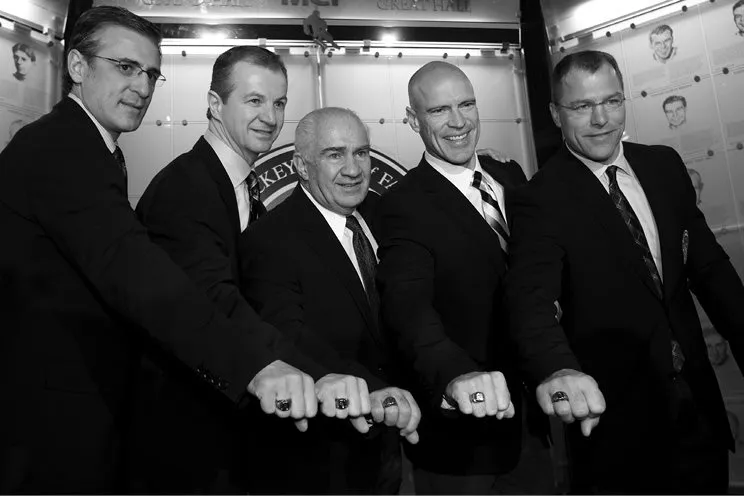
Left to right, the HHOF class of 2007: Ron Francis (player), Al MacInnis (player), Jim Gregory (builder), Mark Messier (player), and Scott Stevens (player). (AP Photo/Adrian Wyld, The Canadian Press)
Today, when David remembers his father, he chokes up. David was born in 1961 and named after Father Bauer, on whom Jim relied for advice and friendship until Bauer’s passing in 1988. David realizes how spoiled he was as a kid, soaking in hockey history as it happened. Because Jim spent so much time on the road for work, David wishes he’d cherished every moment when he was home more. He laughs about his dad learning of his firing through the grapevine, a story Jim told repeatedly later in his life.
After playing Junior B with the Markham Royals and Port Credit Titans, David played NCAA hockey at Elmira College, then a Division II school, before starting a career in banking. But after trying it in the real world, David knew he wanted to live a hockey life like the one his father had. In the early 1990s, David pounced when one of his clients solicited his help as a consultant for the launch of the American Hockey League’s Syracuse Crunch. After David helped the team find its footing, it then asked for his help finding a general manager.
“I asked them, ‘Well, what kind of person are you looking for?’ and they said, ‘Well, someone like a Dave Gregory who has a business background and a hockey background.’ I said, ‘Well, why don’t you ask Dave Gregory?’” David said with a laugh, recalling the way he got his first job in hockey.
After the Crunch, in a time when the AHL and IHL were competing for aspiring NHLers and the AHL was offering favourable deals to prospective owners (including paying for the team over a 10-year period) in an effort to align a club with every NHL team, David worked with a pair of childhood friends to buy an AHL franchise. He went on to lease the Carolina Monarchs and relocate them to New Haven, where he served two seasons as the team’s owner, general manager, and president.
Then, in 2002, when David was in Philadelphia doing some part-time NHL scouting and Jim was there to convince Flyers assistant coach E.J. McGuire to consider joining NHL Central Scouting, McGuire and David ended up sitting together at the game that night. Coincidentally, they knew each other independently of Jim. Before David had gone to Elmira College, McGuire had tried to recruit him to play at State University of New York College with its Brockport Golden Eagles. Then, when David was in Syracuse and New Haven, McGuire was with the Hartford Wolf Pack.
“Well, if I go there, would you come to Central Scouting with me?” McGuire asked David at the Flyers game.
“Well, sure, let’s talk about it,” David said.
Though he questioned whether he should take the job, worrying about concerns of nepotism through the obvious ties to his father, David eventually joined NHL Central Scouting the same year McGuire did in 2005.
To this day, David still works at NHL Central Scouting in his father’s absence, managing its group of scouts under current director Dan Marr. And when he scouts the sport’s best young players, he reminds himself constantly of the advice his dad used to give him when he was a player, informing his evaluations with Jim’s tips.
“I learned a lot about what he thought about players when he evaluated my game,” David said. “A lot of people could pick out Sidney Crosby as the best player in a junior game. But it’s how do you pick out the other guys, the guys that could be that other player that you get later on in the draft? So learning as a young player myself what I had to improve on to be a better player really taught me about what to look for in other players.”
Because Jim stressed the importance of a 200-foot game or gave due credit to the complementary defencemen who could play alongside someone with the talent of a Salming, David learned to appreciate those subtle skills, and the nuances of the game, through him.
Later in life, when Jim’s health began to deteriorate and David would come through Toronto on one of his scouting trips, they got to scout local games together. David calls those moments some of the best of his life. And he never stopped learning new things from his dad. Right until the end, Jim could spot the best players on the ice below them, even as he stepped away from the day-to-day of his various titles with the NHL.
“It wasn’t his job to know, ‘Hey, there are 12 players in this game, some that are barely going to make the list and some that are going to be at the top of the list,’ but he very quickly could know who those players were or would ask, ‘Who’s that player?’” David said. “It was really fun to see how quickly he understood what a talented and complete hockey player was.”
Jim’s hockey life has been passed on to a third Gregory generation now, too. David has three sons of his own and his middle son, Lyle, worked in the Blackhawks’ hockey operations department, developing a player evaluation tool that blends in-person scouting analysis with analytics. After leaving the Blackhawks, Lyle started Champ DAT with that software. David’s youngest son, Kade, also started his own company, Hockey DNA, to help young players choose the right path for their hockey development, whether that’s finding the college that makes the most sense for them or the camp that does.
“There’s this evaluator-teacher thing in all of us. It comes from what all started with my dad,” David said.
David describes his father as tough and resilient, but also as an innovator who was “so darn humble all the time,” the kind of person who would credit countless other names for his success before mentioning his own or would tell anyone who would listen that he was just carrying on what he’d learned from others.
One of Jim’s favourite stories to tell was one David’s Grade 7 teacher had told him during a parent-teacher interview. The morning before the interview, David’s teacher had gone around the room asking each of the students what their parents did. David famously answered plainly, “No, my dad doesn’t work, he’s in hockey.”
Now 61, David has learned to view life in his father’s shadow the same way.
“There has never been anyone like him when you look at what his roots were, where he came from, and what he accomplished. But he always just loved what he did and could not get enough of it,” David said. “I’ve got some of that gene in me too, because it’s not real work. I always use that line with people. People ask me what it’s like working in hockey and I always say, ‘It’s better than a real job.’”
Even in Jim’s moment in the limelight, when he was inducted alongside a legendary HHOF class that also included Mark Messier, Al McInnis, Ron Francis, and Scott Stevens, he spent his speech explaining his genuine disbelief and naming other names.
Al MacNeil. Colin Campbell. Mike Murphy. Gary Bettman. Bill Daly. Father David Bauer. Stafford Smythe. His son, David; daughters, Andrea, Maureen, and Valeri; and wife, Rosalie. They were the Hall of Famers, he insisted during his acceptance speech, tears streaming down his face. It was their homage, he said.
“It’s overwhelming. I tell my friends this: I don’t think I deserve to be in the Hall of Fame,” Jim said, looking over a crowd of the people he’d helped shape, including Sittler and Salming, who both made sure they were in the audience for his induction.
He talked of the four other inductees and how he’d still be general manager of the Leafs if they were on his team. He talked about being in hockey as a privilege and all the many places around the world it had taken him. He argued his induction belonged to minor hockey parents, officials, coaches, and volunteers.
“It’s each one of you people who do that who are the true builders of the game, who work tirelessly with little fanfare behind the scenes to provide little kids with the opportunity to play the game that all of us love so much,” he said.
As he finished his speech, his hands shook. He licked his index finger, and he flipped the pages in front of him on the podium.
“How often does someone get a chance to live a dream?” he asked.
He paused, trying to choke out his last three words.
“I did,” he said, raising a fist. “Thanks.”
David will never forget that moment. But that was his dad. Earnest, true to himself, and filled to the brim with humility.
“He didn’t think that he was in the class of what he actually was in a lot of ways. And those guys were just like, ‘Jim’s the real stud here.’ It’s amazing the things those players said to me and my family,” David remembered. “It was just an unreal experience.”
In the years since Jim’s 2007 induction into the Hall of Fame, David has received similar messages to the ones Messier, Francis, Stevens, and McInnis gave him about his dad, in rinks across the hockey world in his own role with NHL Central Scouting.
He gets them every day. Every. Single. Day.
Your dad was so helpful for me.
Your dad is one of the greatest people.
I can’t thank your dad enough.
You can’t believe how much your dad helped me.
All that love and admiration, a love and admiration that is universally shared in the hockey world, came to a head for Jim at his last draft in 2018, too.
The entire Gregory family didn’t know it would be his last until he told those who were in Dallas (David with NHL Central Scouting, Lyle with the Blackhawks, and Kade as a volunteer) a few days before it started.
When deputy commissioner Bill Daly stepped to the podium on the Saturday morning of the second day to tell the hockey world that it would be Jim’s last draft, he received a standing ovation that prevailed through their speeches.
“Jim is an institution at our league and on this weekend,” Daly said amid applause. “But today will be the last time that he calls out the names of young men selected in an NHL draft.”
Daly paused, allowing the man to his right the time to take it in. Then he finished.
“On a personal note, I can honestly say that Jim is one of the finest human beings I know, and I have been truly privileged and honoured both to work with him and to call him a friend. Please join me in thanking the incomparable Jim Gregory for decades of tireless service to our game,” Daly said, extending his hands to Gregory, who had his own clenched behind his back, as if embarrassed.
“How am I going to talk now?” Gregory said after finally stepping to the empty podium and lowering the mic to his mouth. “Thank you everyone very much. It’s my honour to participate in this draft, in this wonderful city of Dallas. We’ll start off the second round. The first pick in the second round belongs to the Buffalo Sabres.”
In the hours that followed, as each team made its selections, the league’s general managers and chief scouts grabbed microphones of their own to thank Jim for everything he’d given to the game in advance of their selections.
He was their guy. The draft guy. And they wanted him to know it.
“He had been a part of just about every guy in that room’s life in one way or another. It was everyone else getting to hear what I hear every time I’m at the rink,” David said. “It was very emotional for my dad. I grew up with a dad who taught me toughness in a lot of ways, but he was also such a loving guy and as I got older I realized how emotional he is. I was just so happy to hear what people said about him, that’s for sure.”
In the final year of Jim’s life, when his cancer developed and his condition grew graver, Campbell, Daly, Bettman, and Marr encouraged David to move home to Toronto so that he could be around his dad as much as possible in his final days.
He was the same guy right until the end, according to David. For a while, people from around the hockey world came by to visit and share stories with Jim almost daily. Bettman. Daly. Campbell. Sittler. McDonald. Bobby Orr. They all rotated through, sitting in the Gregory family living room to chat and reminisce.
“It got to the point where my mom said, ‘We’ve really got to stop the visits,’ because of where we knew things were headed. But when he had the strength to, he would want those visits. And that’s when he would perk up the most. He would be back to his old self, and it would be crazy. For a few minutes, he would be telling stories and having people laugh,” David said. “And he made everyone else the star all the time. He was always talking about how he was amongst royalty when anyone came to visit him. They were the ones that were the special ones.”